Think Pink
Pink refuses to pick a lane: soft and loud, sweet and defiant, nursery walls and punk album covers. Technically it's just light red, but no one experiences it that way: pink is its own color with its own rules. A pink background can whisper or shout depending entirely on which pink you pick. Below: ready-to-download pink backgrounds, the shades and codes to build your own, and the story behind the color.
Pink color codes
Gallery
A sample of ready-to-use pink backgrounds. Hover any image and hit the download button to grab the full-resolution version.






Ways to use a pink background
- Wallpaper: a pale pink wallpaper is quietly warm on a desktop; a hot pink one is a statement on a phone; every image above downloads at full resolution.
- Plain & solid: pink flatters skin tones better than almost any backdrop, which is why beauty and fashion shoots lean on it; grab an exact shade below.
- Web & design: pink cuts through feeds like nothing else, which is why it keeps cycling back into branding every time design gets too gray.
Shades of pink
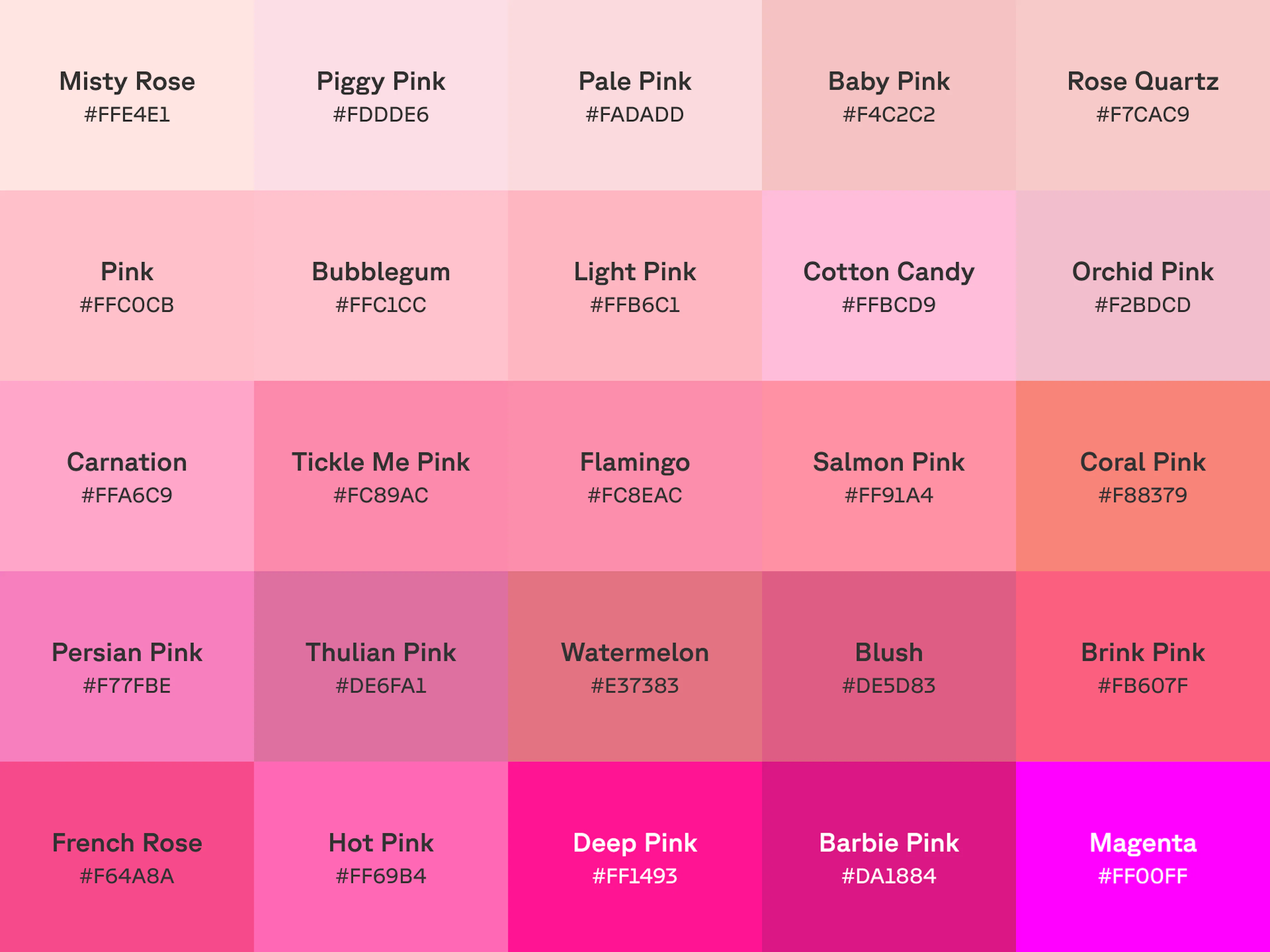
Pink runs from a blush to a shout. The soft end (misty rose, baby pink, rose quartz) barely raises its voice. The middle pinks are the crowd-pleasers: bubblegum, carnation, flamingo. Then the volume goes up: hot pink, deep pink, and magenta, colors with no interest in subtlety.
Click a shade to copy its hex code, or download it as a ready-to-use background:
Design-wise the split is simple: pale pinks behave like warm neutrals and play well with almost anything; hot pinks are accent colors that want the whole stage. Decide which job you're hiring pink for before you pick the shade.
Want even more? Explore the full shades of pink collection.
Pink gradient backgrounds
A pink gradient is a sunset that skipped the orange. Here are six ready-made pink gradients. Copy the CSS straight into a stylesheet, or download the full-resolution image. Want to build your own? Open CSS Gradient and roll a custom pink.
What pink means
Pink's meanings have flipped more than once, which is the most interesting thing about it.
The great pink switcheroo
Pink-for-girls is newer than most people think. Well into the early 20th century, American trade magazines recommended pink for boys ("a stronger color," diluted red) and blue for girls. The convention only locked in around the 1940s, and pink has been renegotiating ever since: Schiaparelli made "shocking pink" high fashion in 1937, punk made it confrontational, millennial pink made it ambient, and Barbie made it a box-office color grade.
Cultural significance of the color pink
Pink is the color of tenderness; cherry blossoms in Japan carry an entire national aesthetic of fleeting beauty. But it also does institutional work: pink ribbons for awareness, pink triangles reclaimed as pride, and "drunk-tank pink," a shade once painted in holding cells because early studies suggested it briefly calmed aggression. Softness has range.
History of pink
Pink pigments began in the garden: rose madder, lifted from madder root, gave painting its blushes and rose tones for centuries. The color got its aristocratic era in 1700s France, where Madame de Pompadour loved a particular porcelain pink so much Sèvres named it after her: Rose Pompadour, arguably history's first branded pink.
The modern era belongs to the loud ones: Schiaparelli's shocking pink, the neon pinks of the 1980s, and magenta, a dye discovered in the 1850s and named after a battle. Magenta has one more claim to fame: it doesn't exist in the spectrum. There's no single wavelength for it; your brain invents magenta to bridge red and blue. Pink's boldest shade is imaginary.
Colophon
While Cool Backgrounds is a fine resource for generating images from popular javascript libraries, the real heavy lifting comes from the library authors themselves. When it comes to customer support, Quinn Rohlf from Trianglify.js is incredibly responsive and a really smart guy to boot. Particle.js is developed by Marc Brüderlin with a wonderful API and is being actively maintained. Gradient Topography is a newly minted project by me as a response to the amazing work by the Codrops crew. And of course Unsplash is one of the best internet treasures of all time, built by the former Crew team as a side project.
Oh yea and can’t forget CSS Gradient and Rellax.js which is the “cool background” that powers those sliding parallax shapes in the content section of this site!